


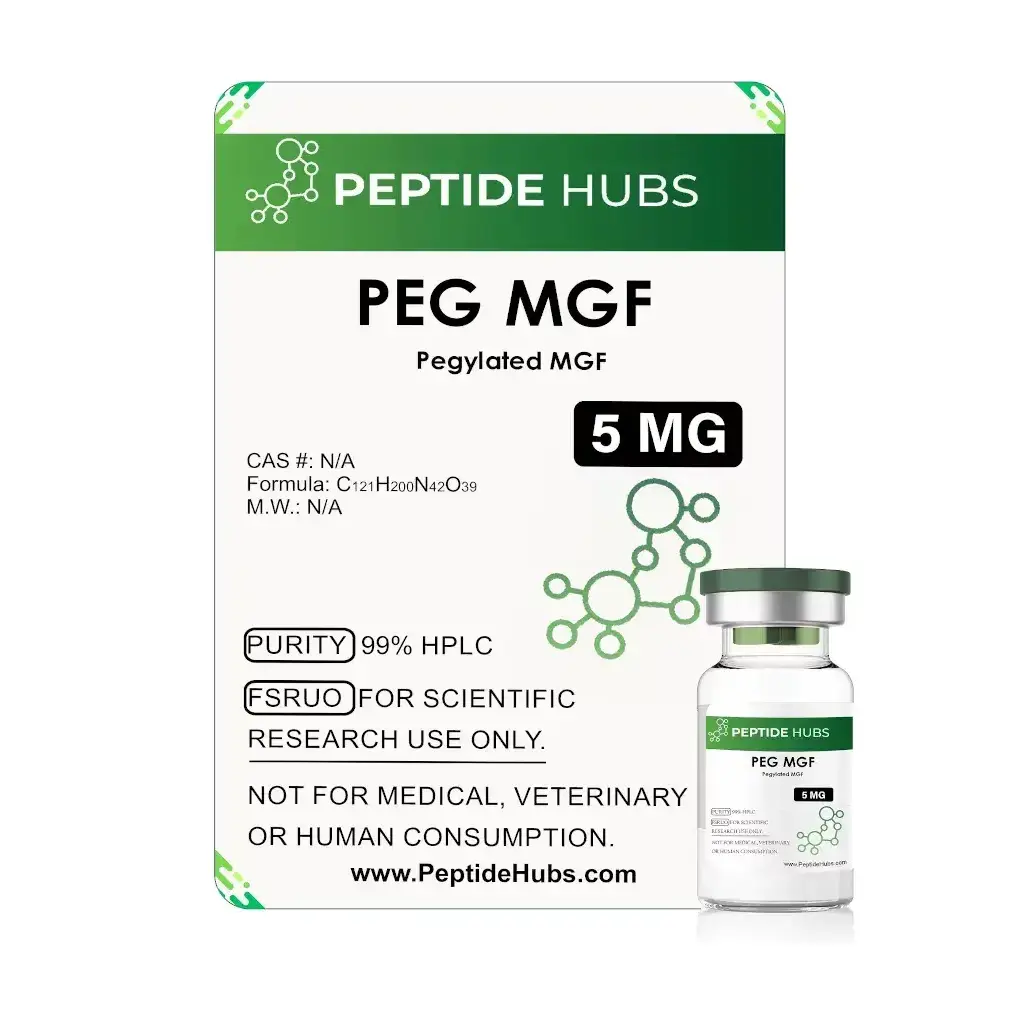
PEGYLATED MGF 5 MG INJECTION
Drug Class: Pegylated Mechano Growth Factor / IGF-1 Splice Variant
Composition:
- Active Substance: Pegylated Mechano Growth Factor (PEG-MGF)
- Concentration: 5 mg per vial
Presentation: 2 mL Vial
Form: Lyophilized Powder for Reconstitution
Manufacturer: Peptide Hubs
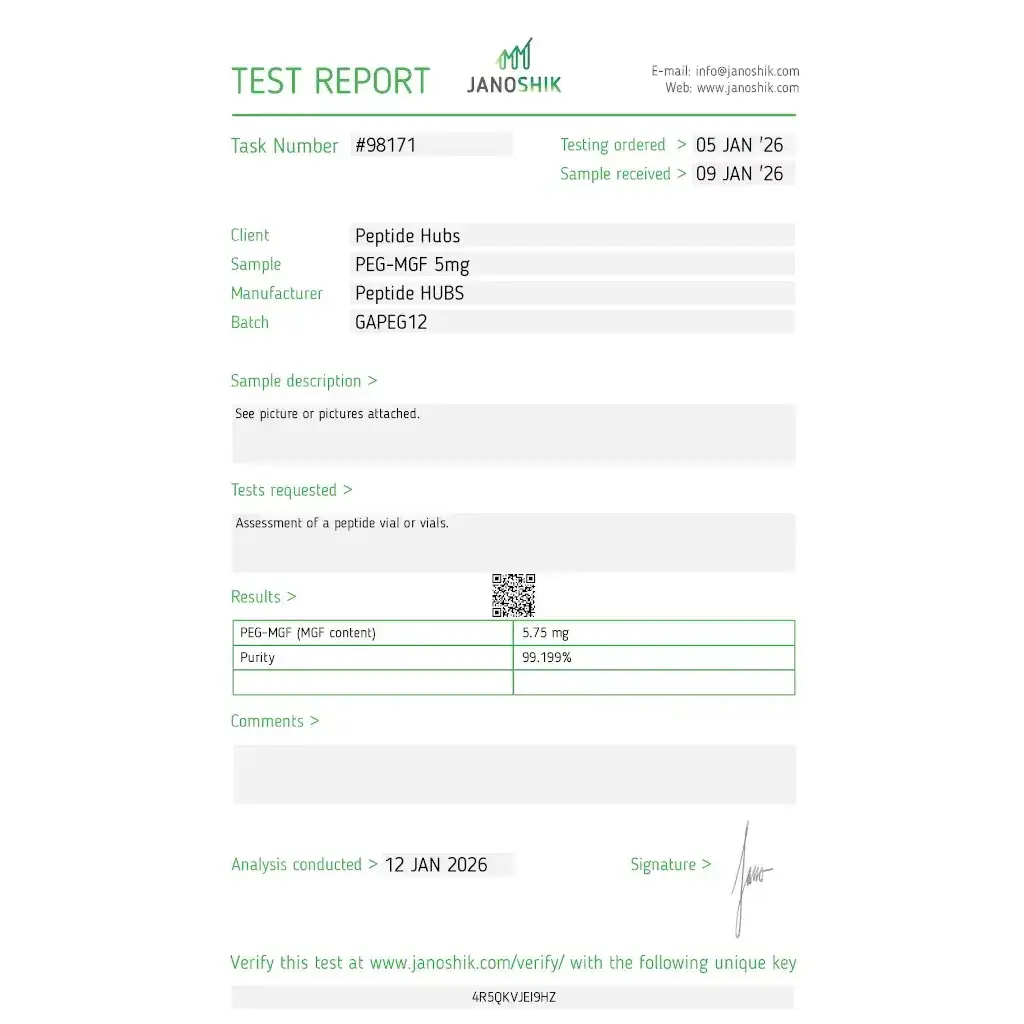
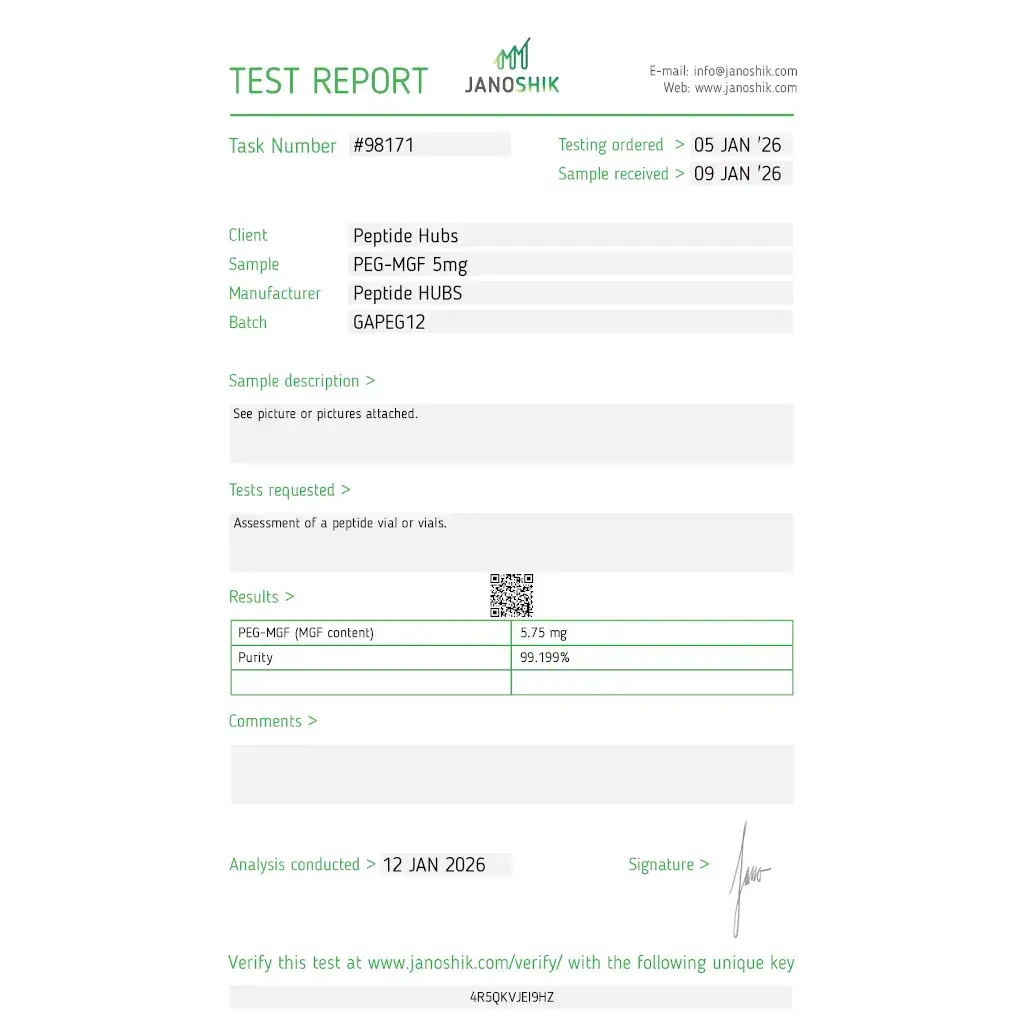
Tested in Laboratory: View Lab Report
Peptide Hubs introduces PEG MGF 5 mg, a specialized research peptide representing a pegylated form of Mechano Growth Factor (MGF), an autocrine splice variant of Insulin-like Growth Factor-1 (IGF-1Ec). The pegylation process attaches polyethylene glycol chains to the peptide, significantly extending its stability and half-life in biological systems, making it an advanced tool for sustained study. This 2 mL vial contains high-purity lyophilized powder designed to activate the IGF-1 receptor and downstream PI3K/Akt pathways, which are central to muscle repair, satellite cell activation, and protein synthesis. As highlighted in research on muscle regeneration and IGF-1 isoforms, MGF plays a distinct, localized role in responding to mechanical stress and damage. Peptide Hubs ensures this product meets rigorous purity standards, providing researchers with a reliable compound for investigating anabolic signaling and tissue regeneration.
The primary research interest in PEG-MGF stems from its unique role as a damage-responsive growth factor. Unlike systemic IGF-1, MGF (and its pegylated form) is studied for its localized, tissue-specific effects following mechanical strain or injury. Key research observations include:
These effects position PEG-MGF as a targeted research tool for muscle plasticity and recovery, rather than a systemic mass-builder.
PEG-MGF is a research peptide, and all dosing protocols are for controlled laboratory studies. The 5 mg vial should be reconstituted with bacteriostatic water. A standard research dilution involves adding 2 mL of diluent, yielding a concentration of 2.5 mg/mL. Due to its localized mechanism, experimental dosing in models often involves site-specific, intramuscular (IM) injection protocols at or near the muscle group being studied, typically post-exercise or post-injury. Dosing is commonly in the range of 50-200 micrograms per injection site. The extended half-life from pegylation allows for less frequent dosing compared to standard MGF—often every other day or even twice weekly in research models. Absolute sterile technique is critical, especially for IM administration protocols.
PEG-MGF is typically studied in shorter, targeted cycles (e.g., 4-8 weeks) aligned with specific training or injury protocols in models, focusing on the repair and growth phases. For comprehensive research on muscle hypertrophy, strength, and full-body anabolism, scientists may design protocols that combine PEG-MGF with other Peptide Hubs compounds to investigate synergistic pathways. These are concepts for experimental design.
In research models, the side effects of PEG-MGF are generally related to its potent local growth-promoting actions. These can include localized swelling, soreness, or redness at the injection site due to the inflammatory phase of repair and fluid retention. A significant research consideration is the theoretical risk of aberrant cell growth; while MGF is involved in regulated repair, uncontrolled stimulation is a topic of scientific scrutiny. There is also the potential for negative feedback on the natural GH/IGF-1 axis with prolonged, high-dose studies. As with all intramuscular injection protocols, the risks of infection, nerve damage, or improper injection technique are heightened and require strict adherence to sterile surgical procedures and ethical oversight.
PEG-MGF's research value is rooted in its unique biology. Mechano Growth Factor is produced locally in muscle fibers in response to mechanical tension and micro-damage. It binds to the IGF-1 receptor but triggers a signaling cascade that emphasizes satellite cell activation and proliferation over direct protein synthesis. The pegylation in this product slows clearance, allowing researchers to maintain elevated local concentrations with fewer administrations, making it a more practical model for studying sustained repair processes. This makes it an exceptional tool for investigating the link between mechanical stimulus (exercise), cellular damage, and the initiation of the hypertrophic response.
These are distinct research compounds. Regular MGF has a very short half-life (minutes). PEG-MGF is a modified version with a much longer half-life (days) due to pegylation. IGF-1 LR3 is a modified, long-acting version of systemic IGF-1 designed for broad anabolic effects. In research, PEG-MGF is used for localized, damage-responsive signaling, while IGF-1 LR3 is studied for systemic nutrient partitioning and whole-body effects.
Because MGF is an autocrine/paracrine factor—it's meant to act where it's produced. Research protocols using intramuscular injection at the target site model this physiological process, aiming to concentrate the peptide's effects on the specific muscle group undergoing repair or growth stimulation. This allows for the study of localized versus systemic effects.
Reconstitute with 2 mL of bacteriostatic water for a 2.5 mg/mL solution. Gently swirl to dissolve; do not shake. Unreconstituted vials must be stored refrigerated at 2-8°C (36-46°F). Once reconstituted, the solution is stable for approximately 30 days when refrigerated. The pegylation enhances stability, but it should still be protected from light and excessive temperature swings.
Yes, while its primary research focus is skeletal muscle, the IGF-1 receptor is present in connective tissue. Some experimental models investigate its potential role, often in combination with other peptides like BPC-157 or TB-500, for supporting the repair of tendons and ligaments by stimulating fibroblast activity and collagen synthesis. This remains a specialized area of preclinical study.
Please log in to write PEG MGF 5 mg review.
SERMORELIN 5 MG INJECTION
Drug Class: Growth Hormone-Releasing Hormone (GHRH)
Composition:
- Active Substance: Sermorelin
- Concentration: 5 mg/vial
Presentation: 2 mL Vial
Form: Lyophilized Powder
Manufacturer: Dragon Pharma
BREMELANOTIDE 10 MG INJECTION
Drug Class: Selective Melanocortin Receptor Agonist
Composition:
- Active Substance: Bremelanotide
- Concentration: 10 mg/vial
Presentation: 2 mL Vial
Form: Lyophilized Powder
Manufacturer: Dragon Pharma
PENTADECAPEPTIDE 2 MG INJECTION
Drug Class: Healing/Repair Peptide
Composition:
- Active Substance: Pentadecapeptide
- Concentration: 5 mg/vial
Presentation: 2 mL Vial
Form: Lyophilized Powder
Manufacturer: Dragon Pharma
Tested in Laboratory: View Lab Report
TESAMORELIN 5 MG INJECTION
Drug Class: Growth Hormone-Releasing Hormone (GHRH)
Composition:
- Active Substance: Tesamorelin
- Concentration: 5 mg/vial
Presentation: 2 mL Vial
Form: Lyophilized Powder
Manufacturer: Dragon Pharma
MELANOTAN 2 10 MG INJECTION
Drug Class: Synthetic Melanocortin Receptor Agonist
Composition:
- Active Substance: Melanotan 2
- Concentration: 10 mg/vial
Presentation: 2 mL Vial
Form: Lyophilized Powder
Manufacturer: Dragon Pharma
Tested in Laboratory: View Lab Report
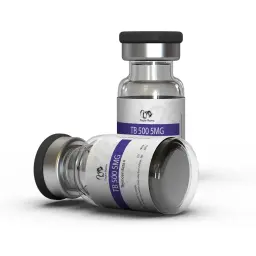
THYMOSIN BETA-4 5 MG INJECTION
Drug Class: Tissue Healing & Recovery Peptide
Composition:
- Active Substance: Thymosin Beta-4
- Concentration: 5 mg/vial
Presentation: 2 mL Vial
Form: Lyophilized Powder
Manufacturer: Dragon Pharma
Tested in Laboratory: View Lab Report