


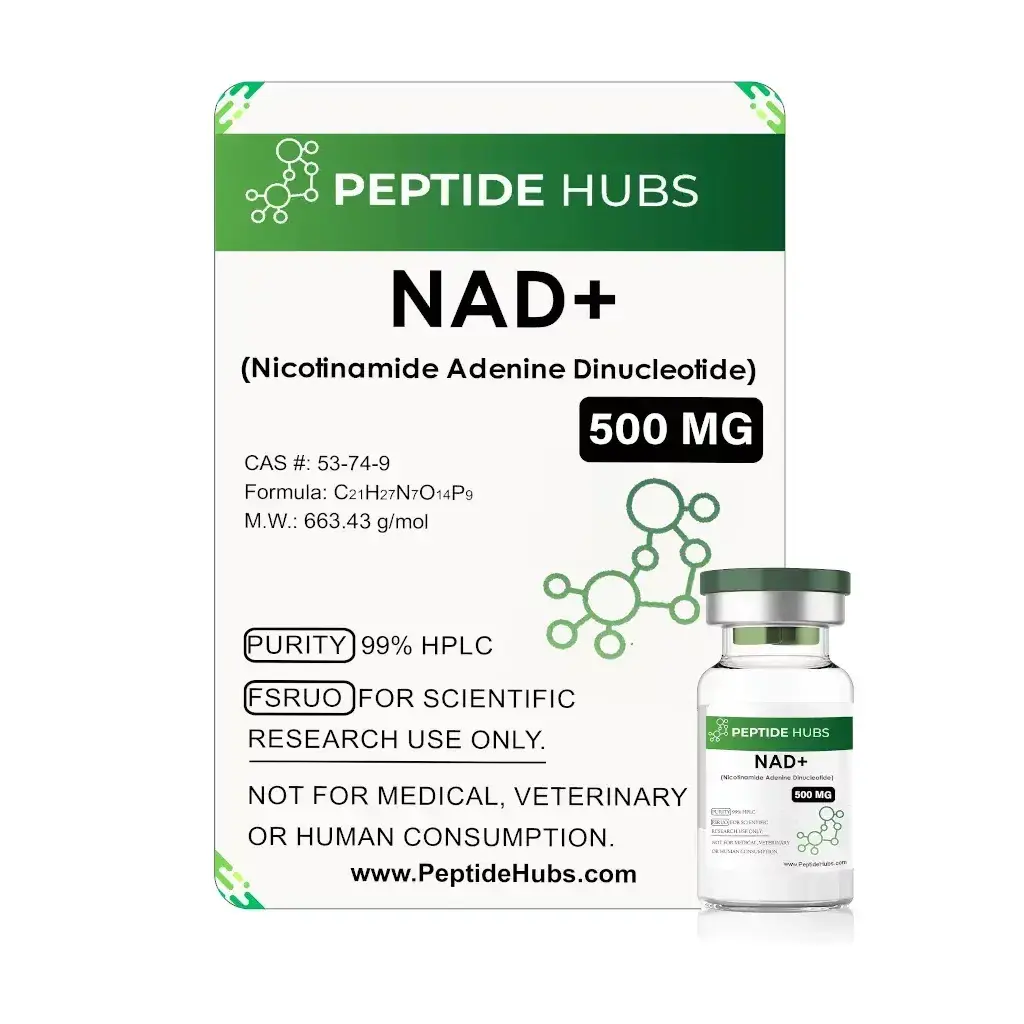
NICOTINAMIDE ADENINE DINUCLEOTIDE 500 MG INJECTION
Drug Class: Essential Coenzyme / Cellular Energy Precursor
Composition:
- Active Substance: Nicotinamide Adenine Dinucleotide (NAD+)
- Concentration: 500 mg per vial
Presentation: 2 mL Vial
Form: Lyophilized Powder for Reconstitution
Manufacturer: Peptide Hubs
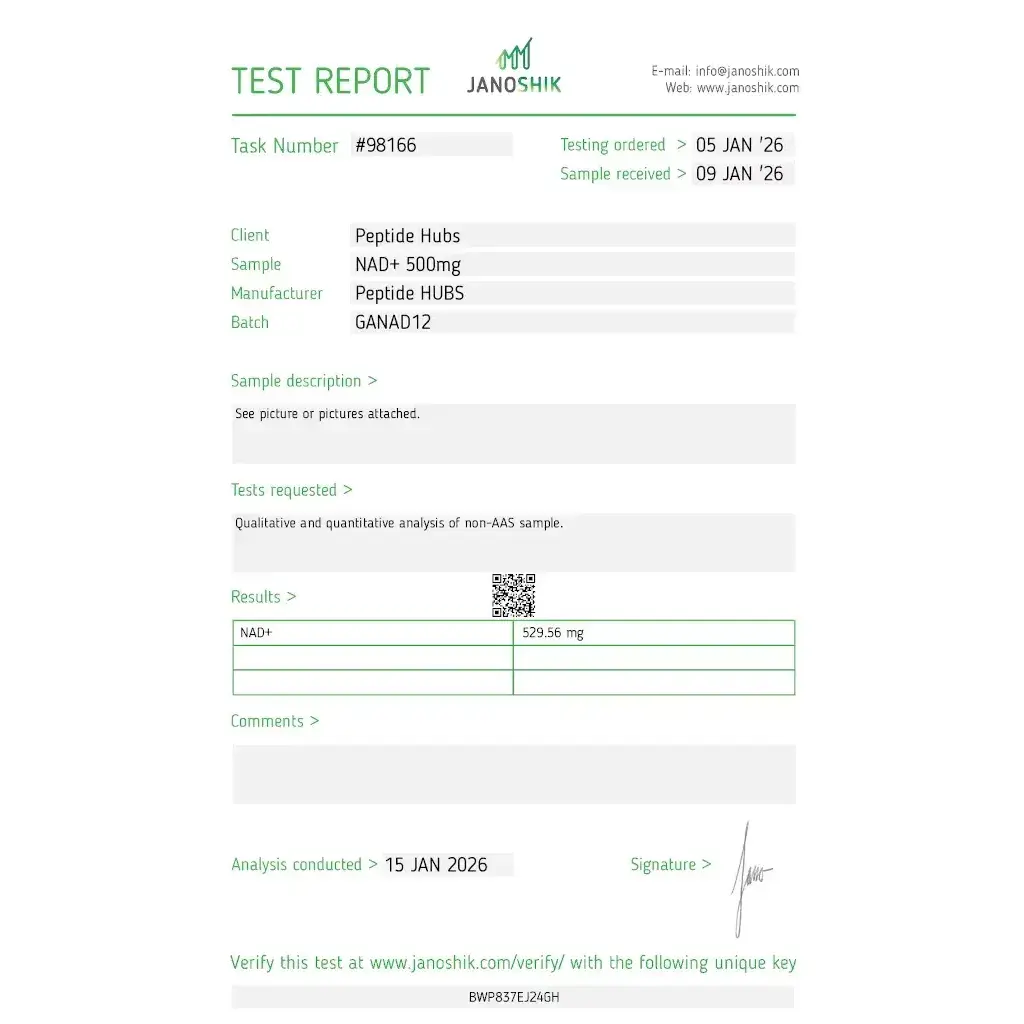
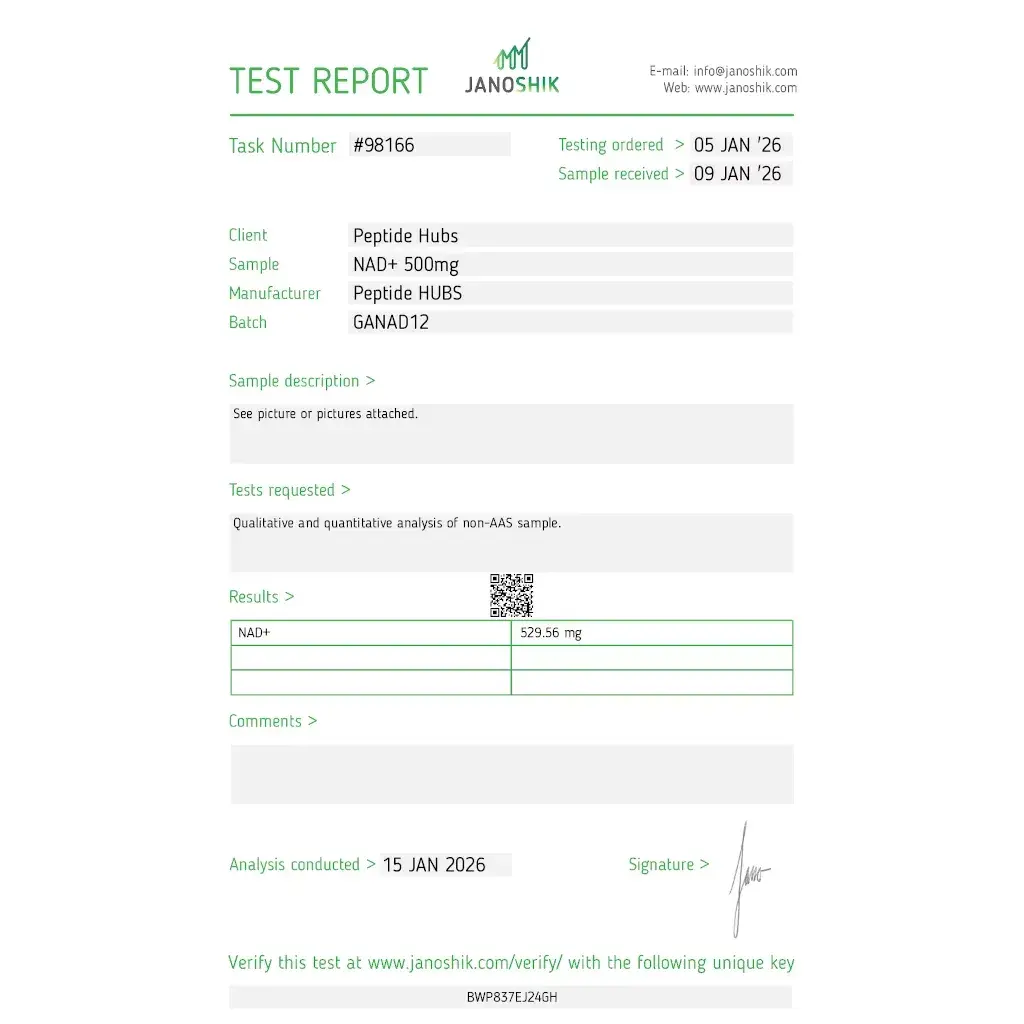
Tested in Laboratory: View Lab Report
Peptide Hubs presents NAD+ 500 mg, a research-grade formulation of the essential coenzyme Nicotinamide Adenine Dinucleotide. Provided as a potent 500 mg lyophilized powder in a 2 mL vial, this product offers a concentrated resource for investigating cellular metabolism, energy production, and longevity pathways. NAD+ is a fundamental redox agent involved in hundreds of enzymatic reactions, serving as a critical electron carrier in mitochondrial ATP synthesis and as a required substrate for sirtuins and PARPsâenzymes governing DNA repair, gene expression, and cellular stress resistance. As emphasized in comprehensive reviews on NAD+ biology, declining cellular NAD+ levels are linked to age-related dysfunction, making its replenishment a key subject in metabolic and aging research. Peptide Hubs ensures pharmaceutical-grade purity for reliable, reproducible scientific inquiry into performance and recovery.
NAD+ operates as a master regulator of cellular energetics and homeostasis. Its research effects are broad and systemic, impacting fundamental processes that underpin performance and health:
NAD+ is a research chemical, and all protocols are for laboratory study. The high-concentration 500 mg vial requires careful reconstitution. Adding 2 mL of bacteriostatic water or sterile saline yields a very concentrated 250 mg/mL solution. For most preclinical models, this is then further diluted for administration. Research dosing varies widely but is typically in the range of 100-500 mg per kg of body weight in animal studies, administered via intraperitoneal (IP) or intravenous (IV) routes to study systemic effects. In models focused on localized effects, subcutaneous or intramuscular routes are explored. Due to NAD+'s rapid metabolism, research protocols often utilize daily or every-other-day administration over cycles of 1-4 weeks to study cumulative effects on tissue NAD+ levels. Sterile technique is paramount, especially for IV or IP studies.
NAD+ research spans from short, acute intervention studies to longer cycles (4-12 weeks) examining chronic adaptation. Given its foundational role, NAD+ is often studied in combination with other compounds that may synergize with or depend on its pathways. The following are research design concepts.
In research models, NAD+ is generally well-tolerated due to its endogenous nature. However, at high research doses, especially with rapid IV administration, transient side effects have been observed. These can include nausea, flushing, sensations of heat or itching, and changes in heart rate or blood pressure, likely related to its vasodilatory properties. A more significant research consideration is the potential for feedback inhibition of NAD+ biosynthetic pathways (the "NR/NMN salvage pathway") with chronic, high-dose exogenous administration, which could theoretically blunt natural production. The primary risks remain technical: improper sterile technique leading to infection, incorrect dosing, and the challenges of IV or IP administration requiring specialized surgical skills and ethical oversight.
NAD+ is not a signaling molecule in the traditional sense; it is a vital cofactor. Its research significance lies in its consumption by three key classes of enzymes: 1) Dehydrogenases in energy metabolism (e.g., in mitochondria), where it is reduced to NADH to carry electrons. 2) Sirtuins (SIRTs), which are NAD+-dependent deacetylases that regulate stress response, metabolism, and epigenetics. 3) PARPs (Poly-ADP-ribose polymerases), which consume NAD+ to repair DNA strand breaks. Declining NAD+ with age or stress limits the activity of these systems. Research with high-dose NAD+ aims to determine if repletion can restore optimal function of these critical pathways, thereby improving cellular resilience, metabolic output, and repair capacity. This makes it a cornerstone compound for foundational healthspan and performance research.
For research, injectable NAD+ bypasses the digestive system and first-pass metabolism, allowing for precise control over systemic concentration and the study of direct effects. Oral precursors like NMN or NR must be converted to NAD+ inside cells, a process that can be inefficient and variable. Injectable NAD+ in models provides a more direct means to elevate plasma and tissue NAD+ levels rapidly, which is useful for studying acute physiological responses.
Due to the high mass, reconstitution with 2 mL of bacteriostatic water is standard, creating a 250 mg/mL solution. This concentrated stock is often then diluted further in a sterile saline bag or syringe for administration in animal models. For example, to achieve a common research dose, the stock solution would be drawn and mixed with additional saline to the desired final volume for IP or IV infusion.
Absolutely. Intense exercise increases NAD+ consumption and oxidative stress. Research investigates whether NAD+ supplementation in models can improve mitochondrial efficiency during exercise (delaying fatigue), enhance post-exercise recovery by supporting cellular repair pathways (sirtuins/PARPs), and improve metabolic flexibilityâthe ability to switch between fuel sources. It's a key compound for studying the molecular basis of endurance and adaptation.
NAD+ is sensitive to heat and light. Unreconstituted lyophilized vials must be stored at -20°C for long-term stability. For active use, they can be kept refrigerated at 2-8°C (36-46°F) for several months. Once reconstituted, the solution is fragile and should be used immediately for research. If storage is necessary, it can be kept refrigerated and protected from light for up to 24-48 hours, but degradation is rapid, so immediate use is the research standard.
Please log in to write NAD+ 500 mg review.
NICOTINAMIDE ADENINE DINUCLEOTIDE 500 MG INJECTION
Class: Essential Coenzyme/Nucleotide
Composition:
- Active Substance: Nicotinamide Adenine Dinucleotide
- Concentration: 500 mg/vial
Presentation: 2 mL Vial
Form: Lyophilized Powder
Manufacturer: Dragon Pharma
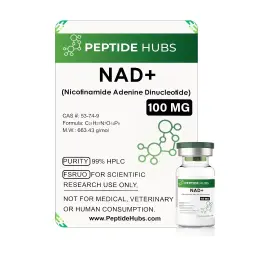
NICOTINAMIDE ADENINE DINUCLEOTIDE 100 MG INJECTION
Drug Class: Coenzyme/Cellular Energizer
Composition:
- Active Substance: Nicotinamide Adenine Dinucleotide
- Concentration: 100 mg/vial
Presentation: 2 mL Vial
Form: Lyophilized Powder
Manufacturer: Peptide Hubs
Tested in Laboratory: View Lab Report
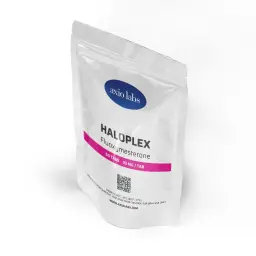
FLUOXYMESTERONE 10 MG TABS
Drug Class: Androgen; Anabolic Steroid
Composition:
- Active Substance: Fluoxymesterone
- Concentration: 10 mg/tablet
Presentation: 50 tablets
Manufacturer: Axiolabs
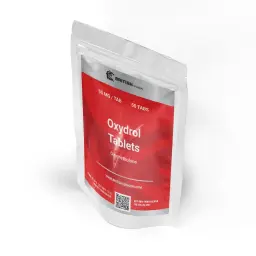
OXYMETHOLONE 50 MG TABS
Drug Class: Androgen; Anabolic Steroid
Composition:
- Active Substance: Oxymetholone
- Concentration: 50 mg/tablet
Presentation: 50 tablets
Manufacturer: British Dragon Pharmaceuticals
Common Name(s): Anadrol, Anapolon, Androlic, Oxybolone, OXY, Oxydex
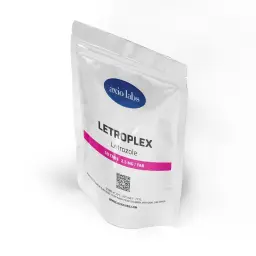
LETROZOLE 2.5 MG TABS
Drug Class: Aromatase Inhibitor; Antiestrogen
Composition:
- Active Substance: Letrozole
- Concentration: 2.5 mg/tablet
Presentation: 50 tablets
Manufacturer: Axiolabs
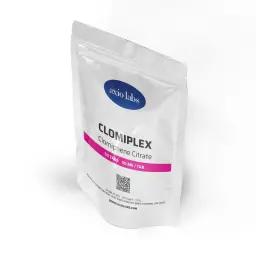
CLOMIPHENE CITRATE 50 MG TABS
Drug Class: Selective Estrogen Receptor Modulator; Progonadotropin
Composition:
- Active Substance: Clomiphene Citrate
- Concentration: 50 mg/tablet
Presentation: 50 tablets
Manufacturer: Axiolabs
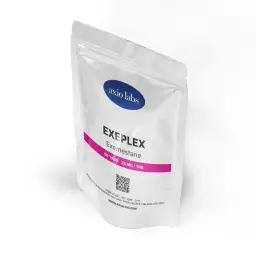
EXEMESTANE 25 MG TABS
Drug Class: Aromatase Inhibitor; Antiestrogen
Composition:
- Active Substance: Exemestane
- Concentration: 25 mg/tablet
Presentation: 50 tablets
Manufacturer: Axiolabs
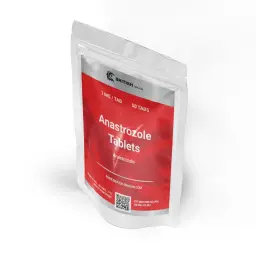
ANASTROZOLE 1 MG TABS
Drug Class: Aromatase Inhibitor; Antiestrogen
Composition:
- Active Substance: Anastrozole
- Concentration: 1 mg/tablet
Presentation: 50 tablets
Manufacturer: British Dragon Pharmaceuticals