


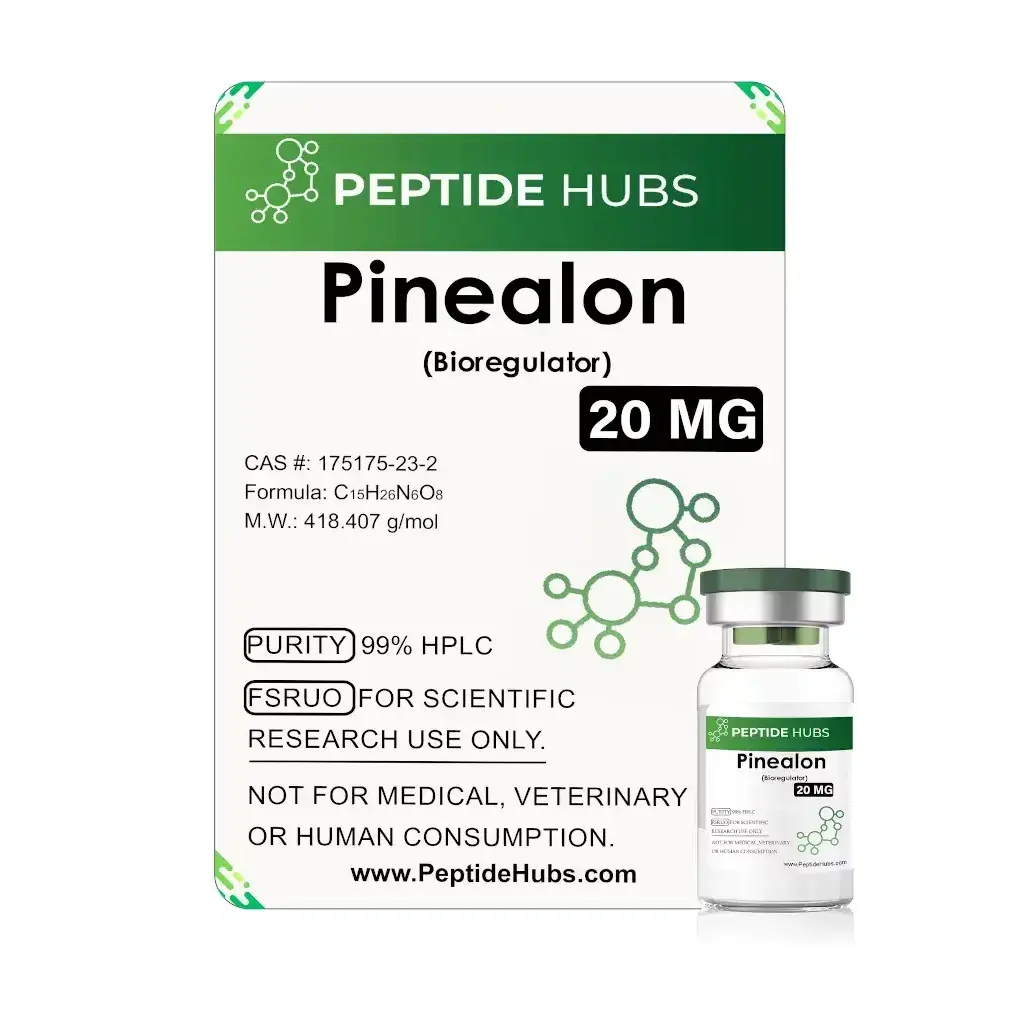
PINEALON 20 MG INJECTION
Drug Class: Synthetic Tripeptide / Neuro-Regulatory Compound
Composition:
- Active Substance: Pinealon (Glu-Asp-Arg)
- Concentration: 20 mg per vial
Presentation: 2 mL Vial
Form: Lyophilized Powder for Reconstitution
Manufacturer: Peptide Hubs
Peptide Hubs presents Pinealon 20 mg, a synthetic tripeptide (Glu-Asp-Arg) designed for advanced research into neural differentiation, oxidative stress response, and cellular homeostasis. Provided as a high-purity lyophilized powder in a 2 mL vial, this compound serves as a precise tool for investigating peptide-mediated control of mitochondrial function and gene expression related to synaptic plasticity. Preclinical models, as discussed in research on neuroprotective peptides, highlight the significance of such compounds in modulating neuronal energy metabolism and resilience. Peptide Hubs ensures each batch of Pinealon meets stringent purity standards, offering reliability for sensitive neurological and metabolic studies.
Pinealon's research value lies in its multi-faceted influence on neural and cellular systems, rather than direct anabolic or metabolic stimulation. Its primary observed effects in experimental models center on neuroprotection and cellular optimization:
These effects position Pinealon as a specialized compound for cognitive endurance and neural health research, not for direct muscle growth.
Pinealon is a research chemical, and all dosing guidelines are for controlled laboratory studies. The 20 mg vial should be reconstituted with bacteriostatic water or sterile saline. A common research dilution is 2 mL of diluent, yielding a concentration of 10 mg/mL. In experimental models, dosing is typically in the low to moderate microgram per kilogram (µg/kg) range. Administration is often via subcutaneous or intraperitoneal injection. Research protocols vary, but many employ once-daily administration over medium-term cycles (e.g., 2-4 weeks) to study cumulative effects on gene expression and cellular adaptation. Extreme precision in measurement and aseptic technique is paramount to ensure peptide stability and experimental validity.
Given its mechanisms, Pinealon is often studied in cycles ranging from 10 to 30 days to observe its effects on neural and mitochondrial adaptation. For comprehensive studies on cognitive performance, recovery from stress (including overtraining), and overall systemic optimization, researchers may design protocols that combine Pinealon with other Peptide Hubs compounds. The following are concepts for experimental design only.
In preclinical research, Pinealon is generally associated with a very low side effect profile due to its endogenous-like structure and targeted actions. However, responsible study design must account for potential reactions. These could theoretically include mild, transient changes in behavior or sleep patterns due to its central nervous system activity. As with any research peptide, the most significant risks are technical: infection from improper sterile technique, inaccurate dosing leading to null or exaggerated results, and the ethical implications of manipulating neural pathways without appropriate oversight. Researchers must adhere to all institutional and ethical guidelines for animal or in vitro studies.
Pinealon (Glu-Asp-Arg) is believed to exert its research effects through modulating intracellular signaling and gene expression. It may influence the activity of key mitochondrial enzymes involved in the electron transport chain, thereby optimizing ATP production under stress. Furthermore, it appears to regulate the expression of genes related to neurotrophic factors (like BDNF) and proteins involved in synaptic structure. This positions Pinealon not as a direct neurotransmitter mimetic, but as a modulator of the cellular environment, making neurons more resilient, efficient, and adaptable. This makes it a valuable tool for research into conditions characterized by oxidative stress, metabolic inefficiency, and impaired plasticity.
The primary application is in neuroscience and cellular biology research, focusing on neuroprotection, mitochondrial bioenergetics, and synaptic plasticity. It is used to model how small peptides can enhance neuronal resilience to oxidative stress, support cellular energy production, and influence gene expression related to learning, memory, and neural adaptation. It's a tool for studying foundational cellular health.
Their mechanisms are distinct. Pinealon is a simple tripeptide believed to work "upstream" by modulating mitochondrial function and gene expression, affecting the neuron's overall health and resilience. Noopept is a synthetic dipeptide with more direct, complex pharmacodynamics potentially affecting AMPA receptors and neurotrophic factors. Pinealon offers a research model focused on cellular infrastructure, while Noopept is often studied for more acute neurochemical effects.
For flexible dosing in research, reconstituting with 2 mL of bacteriostatic water is recommended, resulting in a 10 mg/mL solution. This means each 0.1 mL (or 10 units on an insulin syringe) contains 1 mg of Pinealon. For studies requiring microgram-level precision, researchers may choose to reconstitute with a larger volume (e.g., 4 mL for 5 mg/mL). Always use sterile techniques.
Yes, this is a valid and promising research direction. Intense physical training induces systemic oxidative stress and can burden the central nervous system (CNS). By studying Pinealon's potential to enhance mitochondrial efficiency and neuronal stress resistance, researchers can model its application in mitigating CNS fatigue, improving recovery quality, and maintaining cognitive function during periods of high physical demand.
Please log in to write Pinealon 20 mg review.
SERMORELIN 5 MG INJECTION
Drug Class: Growth Hormone-Releasing Hormone (GHRH)
Composition:
- Active Substance: Sermorelin
- Concentration: 5 mg/vial
Presentation: 2 mL Vial
Form: Lyophilized Powder
Manufacturer: Dragon Pharma
BREMELANOTIDE 10 MG INJECTION
Drug Class: Selective Melanocortin Receptor Agonist
Composition:
- Active Substance: Bremelanotide
- Concentration: 10 mg/vial
Presentation: 2 mL Vial
Form: Lyophilized Powder
Manufacturer: Dragon Pharma
PENTADECAPEPTIDE 2 MG INJECTION
Drug Class: Healing/Repair Peptide
Composition:
- Active Substance: Pentadecapeptide
- Concentration: 5 mg/vial
Presentation: 2 mL Vial
Form: Lyophilized Powder
Manufacturer: Dragon Pharma
Tested in Laboratory: View Lab Report
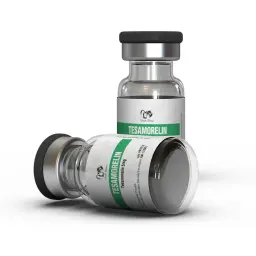
TESAMORELIN 5 MG INJECTION
Drug Class: Growth Hormone-Releasing Hormone (GHRH)
Composition:
- Active Substance: Tesamorelin
- Concentration: 5 mg/vial
Presentation: 2 mL Vial
Form: Lyophilized Powder
Manufacturer: Dragon Pharma
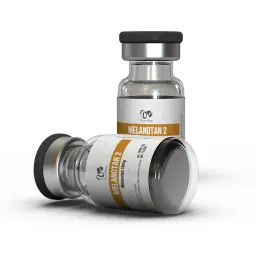
MELANOTAN 2 10 MG INJECTION
Drug Class: Synthetic Melanocortin Receptor Agonist
Composition:
- Active Substance: Melanotan 2
- Concentration: 10 mg/vial
Presentation: 2 mL Vial
Form: Lyophilized Powder
Manufacturer: Dragon Pharma
Tested in Laboratory: View Lab Report
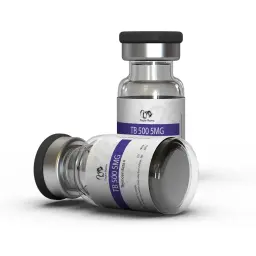
THYMOSIN BETA-4 5 MG INJECTION
Drug Class: Tissue Healing & Recovery Peptide
Composition:
- Active Substance: Thymosin Beta-4
- Concentration: 5 mg/vial
Presentation: 2 mL Vial
Form: Lyophilized Powder
Manufacturer: Dragon Pharma
Tested in Laboratory: View Lab Report